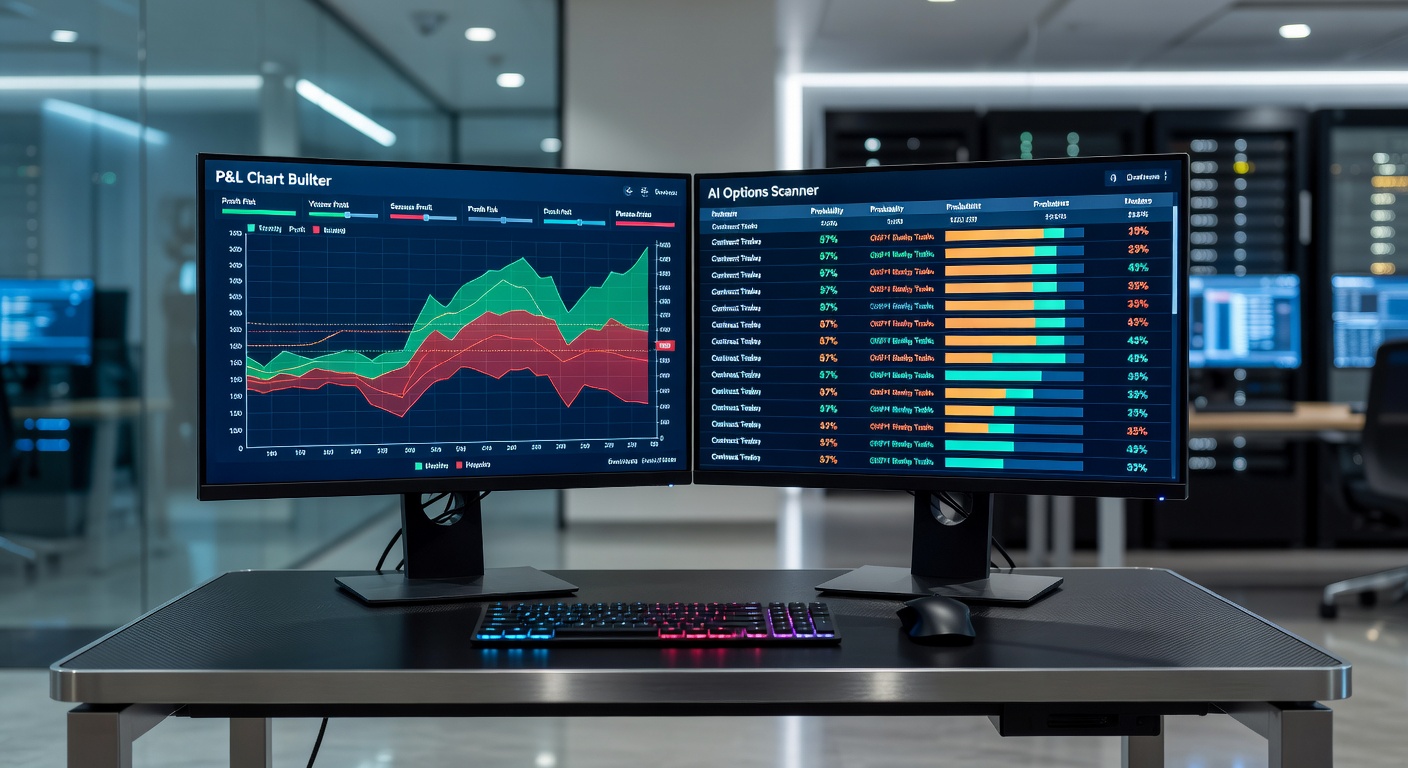
TL;DR: OptionScout and OptionStrat occupy different parts of the options trading workflow. OptionStrat is a strategy visualization platform — pristine P&L charts, multi-leg structure modeling, intuitive payoff diagrams that make complex trades easy to understand before placement. OptionScout is an AI-driven scanner — automated probability ranking across the liquid options universe, real-time gamma exposure, and unusual activity filtering that surfaces trade candidates before you would have thought to model them. The right tool depends on whether your bottleneck is finding trades (OptionScout) or modeling trades (OptionStrat). This comparison lays out where each tool wins, where they overlap, and how active traders combine both.
Key Takeaways
- OptionStrat is the strongest pure visual P&L builder in the retail options analytics space; the interface is best-in-class for traders who already know what trade they want to structure [1]
- OptionScout's distinguishing capability is AI-driven contract ranking — every liquid contract is evaluated daily against implied volatility, skew, historical win rates, and dealer positioning, surfacing trade candidates by expected value rather than by popularity [2]
- OptionStrat costs $40 per month for the full Pro plan; OptionScout is free for the core AI scanner, GEX dashboard, and strategy builder, with a Pro plan available for advanced features
- The two tools overlap in the strategy visualizer category — OptionScout includes a multi-leg P&L builder that handles every common structure, though OptionStrat's visualization polish is somewhat ahead
- Most active traders deploying real capital weekly benefit from a combined workflow: OptionScout for daily idea discovery and probability ranking, OptionStrat for occasional deeper visualization on high-stakes positions
What OptionStrat Does Well
OptionStrat was built around a specific insight: many options traders think about strategies visually, and the standard broker platforms do a mediocre job of making complex multi-leg structures easy to see. OptionStrat solved that problem better than anyone else in the retail space.
The product centers on the visual strategy builder. You select a strategy template (or build a custom multi-leg structure), pick the underlying and the strikes, and OptionStrat renders the payoff diagram, breakeven analysis, and time-decay projection in a clean, color-coded interface. The chart is interactive — drag the strikes, adjust the expiration, watch the P&L curve respond in real time. For traders who learn by seeing rather than by reading numbers, this is genuinely valuable.
OptionStrat's interface quality is its primary differentiator. The strategy templates are well-organized, the P&L chart rendering is sharp and responsive, and the strategy comparison view (showing two or more potential trades side by side) is a standout feature. Educational content embedded throughout the product helps newer traders understand why each strategy works the way it does. For someone who knows they want to compare a 30-delta short put against a 25/30 put credit spread, OptionStrat gets you to a clear visual answer in about 60 seconds [1].
The tool also handles the mechanics of complex structures — calendar spreads, diagonals, broken-wing butterflies, ratio spreads — with a polish that other platforms struggle with. If your trading style involves regular use of these structures, the visualization quality matters and OptionStrat delivers.
The weakness is structural. OptionStrat does not have an opinion about which trades you should be looking at. The platform assumes you already know what you want to model. You bring a thesis ("I want to sell premium on TSLA into earnings, what does the iron condor look like?"), and OptionStrat shows you the answer beautifully. It does not surface the thesis for you. It does not rank a universe of candidate setups by expected value. It does not tell you which contracts have the strongest probability-adjusted edge given current market conditions. That is a different category of tool.
What OptionScout Does Differently
OptionScout was built around a different question: most retail traders' biggest bottleneck is not modeling the trade once they have an idea. It is finding the right idea in the first place. The platform's center of gravity is the AI options scanner, which evaluates the full universe of liquid contracts daily and ranks them by probability-adjusted expected value rather than by volume or popularity [2].
The scanner pipeline weights five inputs: implied volatility relative to realized, volatility skew, historical win rates for similar structures in similar regimes, dealer gamma positioning, and execution liquidity. The output is a ranked list of contracts and structures across stocks, ETFs, and indices, sorted by expected edge. A trader who pulls up the scanner in the morning sees a curated list of setups that the math says are statistically attractive — instead of having to construct the analysis from scratch for each candidate.
The scanner is paired with several supporting tools. The real-time GEX dashboard shows aggregate dealer gamma exposure across SPX, SPY, QQQ, and individual high-OI names — call walls, put walls, and the gamma flip line that signals volatility regime changes. The unusual options activity tracker filters the firehose of large block and sweep orders down to a smaller set of likely directional bets after removing hedging-pattern flows. The strategy builder handles all common multi-leg structures with a P&L visualizer that, while not as polished as OptionStrat's, is functional and integrates directly with the scanner output.
The combined workflow looks like this in practice: the scanner surfaces a top-ten list of probability-ranked setups across the market each morning. You filter by your directional bias and time horizon. You select a candidate, the strategy builder shows the structure, the GEX dashboard tells you whether the underlying is in a positive or negative gamma regime relative to your strikes. You place the trade with a complete picture of the math behind it — without having to manually screen, model, and validate each idea on your own.
OptionScout's distinguishing characteristic is automation of the analytical layer. Where OptionStrat assumes you bring the analysis and asks the platform to visualize it, OptionScout aims to do the analysis itself and surface the conclusions ready to act on.
Head-to-Head Feature Comparison
The following comparison reflects the current state of both platforms as of May 2026.
| Feature | OptionScout | OptionStrat |
|---|---|---|
| AI options scanner with probability ranking | Yes — across full liquid universe daily | No |
| Visual P&L builder for multi-leg structures | Yes — functional, integrates with scanner | Yes — best-in-class polish |
| Real-time gamma exposure (GEX) dashboard | Yes — call wall, put wall, gamma flip | No |
| Unusual options activity filter | Yes — with hedging-pattern removal | No |
| Strategy comparison side-by-side | Yes | Yes — strongest in category |
| Earnings calendar with implied move data | Yes | Yes |
| Backtesting on historical setups | Yes — strategy backtest module | Limited |
| Mobile experience | Functional web | Strong native mobile |
| Free tier | Full scanner + GEX + strategy builder | Limited free tier |
| Paid plan price | Free core; Pro at $9/month | $40/month for full Pro |
| Best for | Trade discovery and probability ranking | Trade visualization and modeling |
The comparison highlights the fundamental product positioning difference. OptionScout's scanner, GEX dashboard, and unusual-activity filter have no direct equivalent in OptionStrat. OptionStrat's visualization polish is somewhat ahead of OptionScout's. The price gap is meaningful: OptionScout's full feature set is available for free or on a $9 Pro plan, where OptionStrat charges $40 monthly for its Pro tier [1].
When OptionStrat Is the Right Choice
OptionStrat is the better pick for several specific use cases:
You build complex structures regularly and visualization is your bottleneck. If your trading style involves frequent calendar spreads, diagonals, broken-wing butterflies, or other structures where the payoff geometry matters and is hard to reason about without seeing it, OptionStrat's chart quality is genuinely worth paying for. The few seconds saved per trade in mental load add up over a high-volume year.
You learn visually and want polished educational integration. OptionStrat's product includes well-designed educational explanations of each strategy's mechanics, embedded directly in the builder. For traders who are still developing their intuition for how each structure behaves under different conditions, this is a meaningful learning aid.
You prefer manual analysis and want a clean tool to model your own ideas. Some experienced traders have their own analytical frameworks and just want a clean platform to render the visualizations. OptionStrat is excellent for that workflow because it does not impose a particular methodology — it just shows you what you ask it to show you, beautifully.
Mobile-first trading workflow. OptionStrat's mobile experience is a step ahead of most competitors in the strategy-builder category. If you frequently model and adjust trades from a phone, the mobile polish matters.
When OptionScout Is the Right Choice
OptionScout is the stronger pick when:
Your bottleneck is finding ideas rather than modeling them. Most active retail options traders we have surveyed describe idea discovery as their actual time sink — not visualization. If you spend more of your week scanning charts and chains looking for setups than you spend modeling trades you have already identified, the AI scanner solves the larger problem.
You want dealer positioning data integrated into your workflow. The GEX dashboard is a substantial differentiator. Traders who incorporate gamma exposure into their decision-making — and the data shows institutional desks have weighted this signal heavily for years — will find no equivalent in OptionStrat.
You trade unusual activity setups and want filtered signals. The unusual options activity tracker with hedging-pattern removal surfaces a curated list of likely directional flow rather than the unfiltered firehose that other UOA tools produce. For traders who use institutional flow as a signal input, the filtering quality is meaningful.
Price matters. $40 per month versus $0-$9 is a real consideration over a year. If OptionScout's feature set covers your workflow, the savings compound.
You are newer to options and want the scanner to teach you what high-probability setups look like. The scanner's probability scoring acts as an implicit education layer — over time, you build intuition for which conditions produce positive expected value, which is harder to develop from a blank-page strategy builder.
How to Use Both Together
Many active traders use OptionScout and OptionStrat in combination, treating them as complementary rather than competitive tools.
A representative workflow: open OptionScout's scanner before market hours. Filter by your directional bias and the time horizon you want to trade. Identify two or three candidates from the top ten. Pull up OptionScout's GEX dashboard to confirm the underlying is in a regime that supports the structure (positive GEX for premium-selling, negative GEX for directional). For the candidates that pass, copy the structure into OptionStrat for the final visualization pass — particularly if the structure is complex or the position size is large enough that you want a polished payoff diagram in front of you before placing the trade.
This combined workflow uses each tool for its strongest capability. OptionScout handles the analytical heavy lifting at the discovery and screening stage, where AI scanning and dealer positioning data add the most value. OptionStrat handles the final visualization stage, where its polish is meaningful for high-stakes confirmation.
The combined cost is $40 per month (OptionStrat Pro) plus $0 to $9 per month (OptionScout free or Pro), depending on your needs. For traders running serious workflows, this is reasonable. For traders earlier in the curve, OptionScout's free tier alone covers the largest portion of the workflow, and OptionStrat can be added later if visualization polish becomes the binding constraint.
Why This Matters in 2026 Options Markets
Retail options volume in 2026 is at all-time highs, with retail accounting for an estimated 40-45% of single-stock options flow during peak earnings windows (OCC, Q1 2026) [3]. The competition for trade ideas is more intense than ever. The difference between a trader who consistently finds high-probability setups and a trader who works hard but trades whatever caught their eye on Twitter is increasingly determined by tooling.
OptionScout's AI scanner directly addresses this idea-discovery bottleneck. OptionStrat's visual builder addresses a different but real bottleneck for traders who already have ideas. Knowing which problem you actually have determines which tool delivers the bigger improvement to your trading.
For most active retail traders in 2026, the binding constraint is discovery. The scanner is the tool that moves the needle. The visualizer is the polish on top. Choose accordingly.
FAQ
Q: Which is better, OptionScout or OptionStrat? A: They solve different problems. OptionStrat is the best visual P&L builder for traders who already know which trade they want to model. OptionScout is the best AI-driven scanner for traders who want the system to surface high-probability ideas automatically.
Q: Is OptionStrat worth $40 a month? A: If you build complex multi-leg structures regularly and visualization is core to your workflow, yes. If your bottleneck is finding ideas, OptionScout's free scanner solves a different and arguably more valuable problem at zero cost.
Q: Can I replace OptionStrat with OptionScout? A: Partially. OptionScout's strategy builder handles all common multi-leg structures with solid visualization. OptionStrat retains an edge on visualization polish if that is your priority.
Q: Does OptionStrat have an AI options scanner? A: No. OptionStrat is centered on the strategy builder. It does not include AI-driven probability ranking across the liquid options universe in the way OptionScout does.
Q: Which platform is better for beginners? A: OptionScout is more beginner-friendly because the AI scanner surfaces high-probability setups with clear probability scoring, removing the burden of identifying ideas from scratch.
Sources
- OptionStrat product testing and documentation, May 2026 — https://optionstrat.com
- OptionScout product documentation and direct testing, May 2026 — https://optionscout.ai
- Options Clearing Corporation Retail Participation Report, Q1 2026 — https://www.theocc.com
- Cboe Global Markets Options Volume Concentration Report, 2025 — https://www.cboe.com