TL;DR: An AI trade advisor worth using does more than scan for unusual volume — it synthesizes options flow, gamma exposure, Greeks, and market structure into ranked setups you can act on. The difference between a useful AI advisor and a glorified screener is contextual reasoning: understanding why flow is unusual, not just that it is. With the rise of unverified tools making bold claims, due diligence on the platform itself matters as much as the trades it recommends.
Key Takeaways
- An effective AI trade advisor combines multiple data layers — flow, gamma exposure, implied volatility skew, and open interest changes — rather than relying on any single signal.
- OptionScout provides options flow analysis, a gamma-exposure (GEX) view, a scanner, alerts, portfolio tracking, and an advisor that ties these layers together [FP-OS-001].
- The SEC warns that fraudsters may pose as legitimate investment professionals or well-known firms using fake websites and social media profiles.
- Speed without context is noise — the advisor's value lies in explaining the thesis behind a setup, not just flagging it.
- Traders who treat AI output as a starting point for their own analysis outperform those who follow signals blindly.
What Makes an AI Trade Advisor Different From a Scanner?
Every broker now offers some flavor of options screening. Set your delta range, minimum volume, maybe an earnings date filter, and you get a list. Lists are not intelligence.
An AI trade advisor operates on a fundamentally different plane. Where a scanner answers "which contracts match these filters," an advisor answers "which setups have a confluence of factors that historically precede directional moves, and what is the risk-reward profile of each."
The distinction matters because options markets generate an extraordinary amount of noise. On any given trading day, thousands of contracts see unusual volume. Most of it is hedging, rolling, or institutional rebalancing — not directional conviction. A raw unusual-activity feed without contextual filtering is worse than useless: it creates the illusion of signal where there is only mechanical flow.
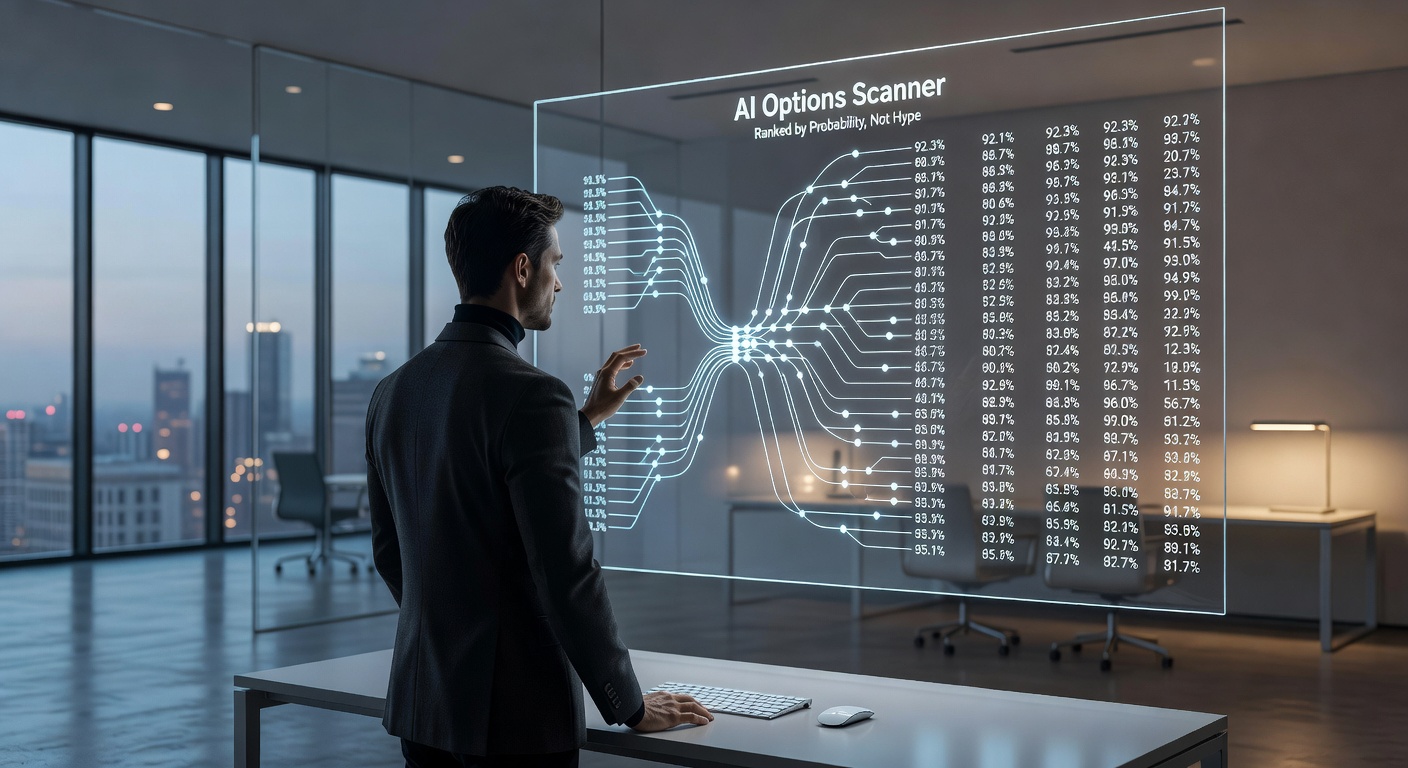
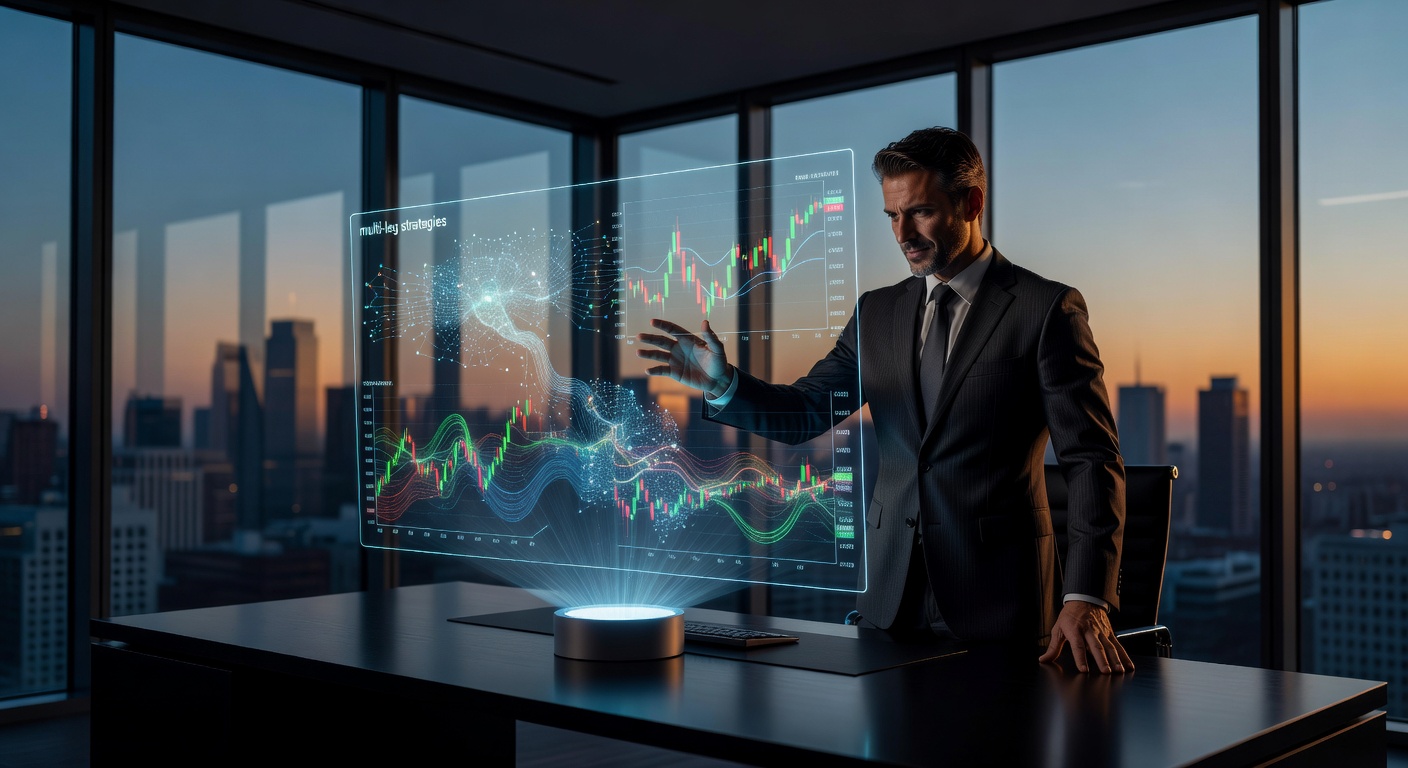
OptionScout's advisor module sits on top of the platform's options flow analysis, gamma-exposure view, scanner, alerts, and portfolio tracking [FP-OS-001]. Instead of presenting each data stream independently and leaving you to synthesize, the advisor correlates across them. When a sweep order hits the tape, the advisor checks whether gamma exposure at that strike supports a squeeze thesis, whether implied volatility is under- or over-pricing the expected move, and whether the open interest structure creates a pin risk or breakout scenario.
That cross-referencing is what separates an advisor from a scanner. It is also what makes AI genuinely useful here — no human can hold the full options chain, the GEX profile, the IV surface, and the flow tape in working memory simultaneously across dozens of tickers.
How Does AI Process Options Flow in Real Time?
The mechanics behind AI-driven options analysis follow a layered architecture. Think of it as three stages: ingestion, correlation, and ranking.
Ingestion captures every options transaction hitting the consolidated tape — sweeps, blocks, splits, multi-leg structures. The AI classifies each trade by aggression (was it at the ask, bid, or mid?), size relative to open interest, and whether it opens new positions or closes existing ones. This classification alone eliminates a huge category of false signals: that massive put volume you saw might be a covered position closing, not a bearish bet.
Correlation maps each classified trade against the current market structure. This is where gamma exposure becomes critical. A large call sweep at a strike with significant negative dealer gamma has a categorically different implication than the same sweep at a strike where dealers are long gamma. In the first case, dealer hedging amplifies the move. In the second, it dampens it. The AI advisor encodes this distinction automatically.
Ranking synthesizes everything into a conviction score. Not every confluence of signals deserves equal capital. The advisor weights recency, size, repetition (are multiple institutions piling into the same strike?), and alignment with the broader GEX profile to produce a ranked list of setups ordered by expected edge.
| Feature | Standard Scanner | AI Trade Advisor |
|---|---|---|
| Volume filtering | Yes | Yes |
| Greeks-based filtering | Sometimes | Always, with cross-Greek analysis |
| Gamma exposure integration | Rare | Core feature |
| Flow classification (sweep vs. block) | Basic | Granular with aggression scoring |
| Multi-signal correlation | No | Yes — flow + GEX + IV + OI |
| Trade thesis generation | No | Yes — explains the "why" |
| Portfolio-aware suggestions | No | Yes — adjusts for existing positions |
| Real-time re-ranking | No | Continuous |
The table above captures why traders who have used both rarely go back. A scanner gives you data. An advisor gives you a thesis you can stress-test.
Why Does Due Diligence on AI Trading Tools Matter More Than Ever?
The explosion of AI-branded trading tools has created a verification problem. Platforms launch with slick interfaces, bold performance claims, and AI buzzwords — but not all of them have the data infrastructure, the modeling rigor, or even the regulatory standing to justify what they promise.
The SEC's Investment Adviser Public Disclosure system exists precisely for this reason. Scammers often pose as legitimate investment professionals or well-known firms using fake websites, encrypted message apps, emails, or social media profiles. The regulator explicitly advises confirming identities through official resources before sending money or sharing personal information.
This warning applies directly to AI trading tools. A platform that provides personalized trade recommendations may meet the regulatory definition of an investment adviser, depending on jurisdiction and the specificity of its output. Traders should verify whether the operators behind any AI tool are registered and in good standing.
The due diligence principle extends beyond registration. Consider what happened in a case documented in SEC filings: a company represented that it had over $4 million in booked work and receivables [1]. Post-closing investigation revealed the financial statements were materially different from what had been presented. The board had relied heavily on information about booked work and receivables that turned out to be misleading.
That pattern — impressive numbers presented without verification, later found to be materially different — maps directly onto the AI trading tool landscape. When a platform claims a particular win rate or average return, ask what data backs it, over what time period, and whether the results are audited or self-reported. The $4 million in booked work looked real until someone actually checked [1]. Performance claims from AI tools deserve the same scrutiny.
What Should You Look for in an AI Options Advisor?
Not all AI advisors are built the same, and the differences that matter most are not always the ones platforms advertise. Here is what separates genuinely useful tools from marketing exercises.
Data depth over data breadth. A platform that ingests options flow, GEX, IV surfaces, and open interest changes — and correlates across all of them — will consistently produce better setups than one that monitors many asset classes superficially. OptionScout focuses its advisor on options-specific data layers including flow analysis, gamma exposure, scanning, alerts, portfolio tracking, and advisory intelligence [FP-OS-001]. That focus means every recommendation is grounded in the full options data stack, not a generalized market signal.
Explainability. If the AI tells you to buy a call spread but cannot articulate why, you have no basis for managing the trade. A good advisor provides the thesis: "Repeated sweep activity at this strike, negative dealer gamma suggests amplification potential, IV is below the recent earnings move average, and the risk-reward on a vertical spread structures favorably." That explanation lets you stress-test the idea against your own read of the market.
Portfolio awareness. An advisor that recommends adding long gamma when your portfolio is already heavily long gamma is not advising — it is listing. The best AI tools adjust recommendations based on your current positions, net Greeks, and sector exposure to suggest trades that improve your overall portfolio profile rather than stacking redundant risk.
Transparency about limitations. No AI system predicts the future. The honest ones frame their output as probability-weighted setups, not guaranteed outcomes. If a platform's marketing suggests certainty, that is a red flag — and one the SEC has specifically warned about in the context of fraudulent investment offers.
How Does Gamma Exposure Integration Change the Advisor's Output?
Gamma exposure is the single most underappreciated input in retail options analysis. Most traders track volume and open interest. Fewer track GEX. Almost none integrate GEX into their trade selection process systematically.
Here is why GEX integration transforms the advisor's output: dealer positioning determines how the underlying moves through key price levels. When dealers are short gamma at a particular strike, their hedging activity amplifies moves through that level — they buy as price rises and sell as price falls, creating a feedback loop. When dealers are long gamma, the opposite happens: their hedging dampens moves, creating mean-reversion behavior around that strike.
An AI advisor that incorporates GEX can distinguish between a sweep at a strike where the trade thesis will be amplified by dealer hedging and a sweep at a strike where dealer hedging will work against the trade. This distinction alone can flip the expected value of a setup from positive to negative.
OptionScout integrates its GEX view directly into the advisor's recommendation engine [FP-OS-001]. When the advisor surfaces a setup, the GEX context is baked into the conviction score — not presented as a separate chart the trader must interpret independently. This integration removes a cognitive step that most retail traders either skip or get wrong.
The practical impact shows up most clearly in short-dated trades. On a weekly or daily expiration, gamma effects dominate delta effects as expiration approaches. A standard scanner that ignores GEX will recommend the same setups regardless of dealer positioning. An AI advisor that accounts for GEX will suppress setups where dealer hedging works against the thesis and amplify those where it works in favor.
What Role Does the Advisor Play in Risk Management?
The best trade idea in the world is worthless if it blows up your account. AI trade advisors add genuine value on the risk side — arguably more than on the entry side.
Position sizing is the first layer. Based on your account size, existing positions, and the volatility of the proposed trade, the advisor can recommend an allocation that keeps any single loss within acceptable bounds. This is not exotic math, but it is math that most traders skip in the heat of a fast-moving market.
Correlation risk is the second layer. If your portfolio is already long five semiconductor names and the advisor suggests a call spread on another chip stock, the correlation-adjusted risk is higher than the standalone risk of that single trade. Portfolio-aware advisors flag this explicitly.
Exit planning is the third layer. An AI advisor can monitor the conditions that formed the original thesis and alert you when they deteriorate — when the flow that triggered the setup reverses, when GEX shifts from amplifying to dampening, or when IV expansion has already priced in the expected move. These dynamic exit signals beat static profit targets and stop losses because they respond to the same data that generated the entry.
OptionScout's portfolio tracking and alerts work in concert with the advisor to provide this full-cycle risk management [FP-OS-001]. The system does not just find trades — it monitors them through their lifecycle and flags when the thesis breaks down.
Why This Matters
The options market in late-stage bull runs tends to attract a surge of new participants and a corresponding surge of tools promising easy edge. History shows that most of those tools — and most of those participants — do not survive the next volatility event.
What separates durable trading tools from hype-cycle casualties is data rigor, transparent methodology, and honest risk framing. The SEC continues to warn about impersonation schemes and fraudulent investment offers, and the AI trading space is not immune to these risks.
For traders evaluating AI advisors today, the question is not whether AI can improve options trading — it demonstrably can, by processing more data faster and correlating across dimensions that exceed human working memory. The question is whether a specific tool does the hard work of genuine multi-layer analysis or merely wraps a basic scanner in AI marketing language.
The tools that survive will be the ones that explain their reasoning, integrate gamma exposure and flow data at the recommendation level, account for existing portfolio risk, and maintain transparency about what they can and cannot do. Everything else is noise dressed up as signal.
FAQ
What does an AI trade advisor actually do for options traders?
It ingests live options flow, open interest shifts, implied volatility surfaces, and gamma exposure data, then flags setups that match predefined or adaptive strategy criteria. The key difference from manual analysis is speed and cross-correlation — the AI holds the full data stack in memory simultaneously and identifies confluences that a human scanning multiple screens would miss or arrive at too slowly to act on.
Can an AI trade advisor replace a human trader entirely?
No. AI excels at pattern recognition and processing speed across thousands of contracts, but position sizing decisions, risk tolerance calibration, and final execution judgment remain human responsibilities. The most effective use of an AI advisor is as a co-pilot that narrows the field to high-conviction setups, leaving the trader to apply discretion on sizing, timing, and trade management.
How do I verify that an AI trading tool is legitimate?
Start with regulatory databases. The SEC and FINRA maintain public disclosure systems where you can confirm whether a firm or individual is registered and whether they have any disciplinary history. Beyond registration, scrutinize performance claims — ask whether results are audited, what time period they cover, and whether they account for survivorship bias. Platforms that resist transparency on these points deserve skepticism.
Is an AI trade advisor useful for small accounts?
Absolutely. Smaller accounts cannot afford to scatter capital across low-conviction setups. An AI advisor's primary value for small accounts is filtration — concentrating limited capital on the setups with the strongest confluence of signals rather than chasing every unusual-activity alert. The risk management features also matter more at smaller scales, where a single outsized loss has a proportionally larger impact.
What is the difference between an AI trade advisor and a standard options scanner?
A scanner filters contracts by static criteria like minimum volume, delta range, or days to expiration. An AI advisor layers contextual analysis on top — correlating flow anomalies with gamma exposure profiles, earnings proximity, implied volatility rank, and historical pattern outcomes. The scanner tells you what happened. The advisor tells you what it likely means and how to structure a trade around it.
Sources
[1] sec.gov. https://www.sec.gov/Archives/edgar/data/1082562/000110801702001859/exhibit10.htm