TL;DR: AI options scanners have moved beyond basic volume filters into multi-signal pattern recognition that weighs order flow, Greeks, and market structure simultaneously. The best scanners now isolate institutional sweeps from retail noise, flag gamma exposure shifts before they drive price, and let traders customize filters for their specific strategy. Choosing the right scanner — and verifying the platform behind it — is as important as the trades it surfaces.
Key Takeaways
- AI-powered scanners analyze dozens of contextual signals at once — delta-adjusted volume, sweep timing, open interest changes, and cross-asset correlations — to surface structurally meaningful trades rather than raw volume spikes.
- The SEC warns traders to verify credentials through official regulatory resources and to be wary of platforms implying government endorsement.
- Customizable filter stacks let traders isolate flow by expiration window, order type, and Greeks exposure, which separates speculative noise from positioning with conviction.
- OptionScout provides options flow analysis, a gamma-exposure (GEX) view, a scanner, alerts, portfolio tracking, and an advisor [FP-OS-001].
- The gap between a scanner that shows you everything and one that shows you what matters is the difference between information overload and actionable edge.
What Makes an AI Options Scanner Different from a Traditional Screener?
Traditional options screeners work like database queries. You set static filters — minimum volume, price range, expiration window — and the screener returns every contract that matches. The problem is obvious to anyone who has tried it: you get hundreds of results, most of them meaningless. A stock with high call volume might just be a covered call roll. A spike in put activity might be a hedge, not a directional bet.
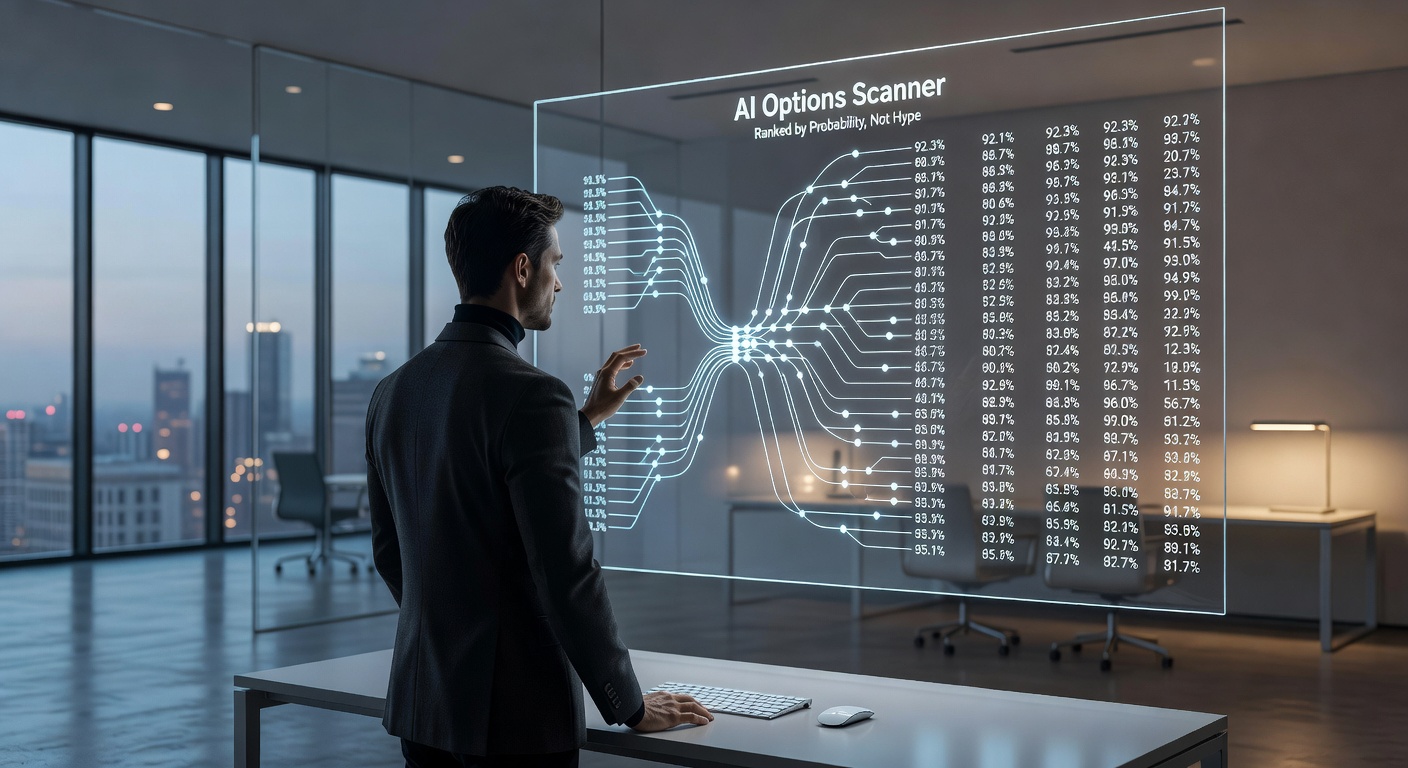
AI scanners operate on a fundamentally different principle. Instead of filtering on isolated metrics, they evaluate combinations of signals and weigh them against learned patterns. When a scanner sees a block of calls bought at the ask, it simultaneously checks whether open interest is building or rolling, whether the delta exposure is concentrated at a single strike, whether similar activity appeared in correlated names, and whether the timing aligns with known catalyst dates.
This is not a minor improvement. It is the difference between a metal detector beeping at every bottle cap on the beach and one that distinguishes aluminum from gold.
The practical result is fewer, higher-quality alerts. A good AI scanner might surface a handful of setups per session instead of dozens. Each one arrives with context: why this flow looks unusual, what the Greeks imply about the positioning, and where the risk inflection points sit.
How Do Modern AI Scanners Filter Options Flow?
The evolution of scanner filtering over the past year has been substantial. Early AI scanners applied machine learning to a narrow set of inputs — mostly volume and open interest. Current-generation scanners work with a much richer feature set.
Delta-adjusted volume is now table stakes. Raw volume tells you how many contracts traded. Delta-adjusted volume tells you how much directional exposure those contracts represent. A thousand contracts of deep out-of-the-money calls represent far less directional conviction than a thousand at-the-money calls. Scanners that normalize for this produce dramatically cleaner signals.
Sweep detection has gotten more sophisticated. A sweep order — one that lifts offers across multiple exchanges simultaneously — indicates urgency. The buyer wants size now and is willing to pay up for it. Modern scanners not only detect sweeps but classify them by aggressiveness, tracking how far above the mid-price the buyer paid and whether the sweep was isolated or part of a cluster.
Multi-leg identification matters because institutional traders rarely express a view with a single contract. They trade spreads, straddles, risk reversals, and custom structures. A scanner that only sees individual legs might flag the long call of a vertical spread as bullish activity, missing that the short call above it caps the position. The best scanners reconstruct multi-leg structures from the tape, giving you the actual strategy rather than its components.
Expiration segmentation is where strategy-specific filtering gets powerful. A 0DTE trader cares about same-day flow and gamma exposure. A swing trader tracking earnings positioning wants to see activity building in the monthly or quarterly expiration. Filtering by expiration window lets each trader see the flow that matches their holding period.
| Filter Type | What It Measures | Best For |
|---|---|---|
| Delta-adjusted volume | Directional exposure per contract | Separating conviction from noise |
| Sweep detection | Order urgency and aggressiveness | Spotting institutional entries |
| Multi-leg reconstruction | Actual strategy vs. individual legs | Understanding positioning intent |
| Expiration segmentation | Flow by time horizon | Matching signals to your strategy |
| Open interest change | New positions vs. closing trades | Identifying fresh conviction |
| Cross-asset correlation | Related flow in ETFs, futures, indices | Confirming sector-wide themes |
OptionScout combines several of these filters into a unified scanner alongside its options flow analysis, GEX view, alerts, portfolio tracking, and advisor tools [FP-OS-001]. The value of an integrated platform is that scanner alerts connect directly to the analytics needed to evaluate them — you do not have to bounce between tabs or tools to go from alert to analysis to decision.
Why Due Diligence on Your Trading Tools Matters as Much as the Trades
Choosing a scanner is a trust decision. You are relying on a platform to accurately parse the options tape, correctly classify order types, and surface signals without bias. That trust should be earned, not assumed.
The SEC emphasizes that traders should confirm identities through official regulatory resources like IAPD or FINRA BrokerCheck before sharing personal information or sending money. This applies to trading platforms just as much as it applies to investment advisers. A platform that implies regulatory endorsement or makes outcome guarantees should raise immediate red flags.
Financial misrepresentation is not theoretical. SEC filings reveal cases where companies claimed over $4 million in booked work and receivables that turned out to be misleading upon closer due diligence investigation [1]. If that kind of discrepancy surfaces in formal corporate agreements subject to regulatory oversight, imagine how much easier it is for an unregulated scanner provider to overstate accuracy metrics or backtest results.
The SEC specifically warns traders to be alert to impersonation of professionals and firms, noting that scammers often pose as legitimate investment professionals using fake websites, encrypted message apps, emails, or social media profiles. In the trading tools space, this manifests as copycat platforms that mimic the UI and branding of established scanners while providing fabricated data.
Before committing to any scanner, verify three things: the company behind it is real and reachable, the data source is identified (most legitimate scanners use OPRA feed data), and the platform does not promise specific trading outcomes. Analytics platforms provide information. They do not provide certainty.
How Should You Evaluate Scanner Accuracy?
Scanner accuracy is a slippery concept because different traders define it differently. For a momentum trader, accuracy might mean the stock moved in the predicted direction within an hour. For a swing trader, it might mean the position was profitable at expiration. For a flow analyst, it might simply mean the scanner correctly identified the order type.
The most honest way to evaluate a scanner is to paper trade its signals for at least two to three weeks before risking capital. Track not just win rate but expectancy — the average gain on winners versus the average loss on losers, weighted by frequency. A scanner that surfaces setups with modest win rates but excellent risk-reward ratios can still produce positive expectancy.
Watch for survivorship bias in scanner marketing. Platforms love to highlight their best calls. The calls that went nowhere or lost money rarely make the promotional material. If a platform claims high accuracy rates, ask how that number was calculated, over what time period, and what the exit criteria were.
Also consider signal-to-noise ratio over raw accuracy. A scanner that produces five alerts per day with three winners is more useful than one producing fifty alerts with fifteen winners. Your attention is a finite resource. A scanner that demands you evaluate fifty possibilities to find the good ones is shifting the analytical burden back to you — which defeats the purpose.
What Role Does Gamma Exposure Play in AI Scanning?
Gamma exposure has become one of the most powerful contextual layers for scanner output. When a scanner flags unusual call buying at a specific strike, the gamma exposure profile at that strike tells you whether dealer hedging will amplify or dampen the move.
At strikes with high positive gamma, dealers are already long the underlying as a hedge. Additional call buying forces more hedging, creating a feedback loop that can accelerate price movement. Scanners that overlay GEX data on flow alerts help traders distinguish between setups that have structural tailwinds and those that will face resistance.
Negative gamma zones are equally important. When the market sits in negative gamma territory, dealer hedging works in reverse — selling into declines and buying into rallies, amplifying volatility in both directions. Flow signals that appear in negative gamma environments carry different risk profiles than the same signals in positive gamma.
OptionScout integrates its GEX view directly with the scanner and flow analysis tools [FP-OS-001], so traders can evaluate whether a flagged setup sits in a gamma environment that supports or undermines the directional thesis. This contextual layering is what separates a scanner that tells you what happened from one that helps you understand what it means.
For traders focused on gamma exposure mechanics, the connection between flow signals and dealer positioning is where the real edge lives. A sweep of calls at a strike where gamma is already concentrated tells a different story than the same sweep at an isolated strike with minimal open interest.
How Do You Build a Scanner Workflow That Actually Works?
The scanner is the starting point, not the endpoint. Traders who treat scanner alerts as trade signals — buying calls the moment an alert fires — consistently underperform those who use alerts as research prompts.
A productive scanner workflow has three phases. First, the scanner surfaces candidates based on your filter criteria. Second, you evaluate each candidate against your own analysis framework — checking the chart, confirming the thesis, sizing the risk. Third, you execute only the setups that survive both the algorithmic filter and your manual review.
This two-layer approach catches false positives that even sophisticated scanners miss. An AI might correctly identify an unusual sweep, but it may not know that the company has a secondary offering priced for tomorrow, or that the CEO is scheduled to speak at a conference in an hour. Context that lives outside the options tape still matters.
Set your scanner filters tight rather than loose. It is better to miss a marginal setup than to drown in noise. Start with the filters that match your strategy — if you trade 0DTE, focus on same-day expiration flow with high delta and sweep classification. If you trade earnings plays, focus on the nearest monthly expiration and watch for straddle and strangle construction in the weeks before the announcement.
Review your scanner results at the end of each week. Track which filter combinations produced the setups you actually traded and which ones generated noise you ignored. Over time, you will tune your filters to match the way you think about markets, and the scanner becomes an extension of your analytical process rather than a separate system competing for attention.
Why This Matters
The options market generates an enormous volume of data every session. Thousands of contracts trade across hundreds of strikes and expirations on each underlying. No human can process that tape in real time. AI scanners compress that data into actionable signals — but only if the scanner is well-built, the filters are well-configured, and the trader brings their own judgment to the final decision.
The proliferation of AI-powered trading tools means the bar for what counts as an edge keeps rising. Running a basic volume screener was a genuine advantage five years ago. Today it is table stakes. The traders gaining an informational edge are the ones using scanners that understand order flow context, incorporate Greeks exposure, and overlay market structure data like gamma positioning.
At the same time, the growth in trading tool platforms means traders must be more discerning about which tools they trust. The SEC continues to warn investors about fraudulent schemes and impersonation, and those warnings apply directly to the trading analytics space. A legitimate scanner is transparent about its data sources, honest about its limitations, and focused on providing analysis rather than promising outcomes.
The traders who will thrive are the ones who treat their scanner as a research assistant — fast, thorough, and tireless — while keeping the decision-making authority where it belongs: with the trader who understands their own risk tolerance, time horizon, and market thesis.
FAQ
What does an AI options scanner do differently than a traditional screener?
An AI scanner applies machine learning to options flow, Greeks, and market structure data simultaneously. Traditional screeners filter on static criteria like volume or price. AI scanners weigh dozens of contextual signals — order timing, delta-adjusted volume, open interest changes, and cross-asset correlations — to surface trades that look structurally meaningful rather than just noisy.
Can an AI options scanner guarantee profitable trades?
No scanner, AI-powered or otherwise, guarantees profits. What a good scanner does is compress the time between opportunity and awareness. You still need a thesis, position sizing, and risk management. The edge is informational speed and pattern recognition, not certainty.
How do I verify that a trading analytics platform is legitimate?
Check the SEC Investment Adviser Public Disclosure database or FINRA BrokerCheck to confirm credentials. Be skeptical of platforms promising guaranteed returns or implying regulatory endorsement. Legitimate platforms focus on analytics and education, not outcome promises.
What filters matter most in an AI options scanner?
Delta-adjusted volume, unusual open interest spikes, sweep detection, and multi-leg identification tend to produce the highest-signal results. Filtering by expiration window — especially isolating same-day versus multi-week flow — helps separate speculative noise from institutional positioning.
Is an AI options scanner useful for swing traders or only day traders?
Both. Day traders benefit from real-time sweep alerts and gamma exposure shifts. Swing traders use scanners to track accumulation patterns over days, spot earnings positioning early, and monitor changes in put-call skew across expirations.
Sources
[1] sec.gov. https://www.sec.gov/Archives/edgar/data/1082562/000110801702001859/exhibit10.htm