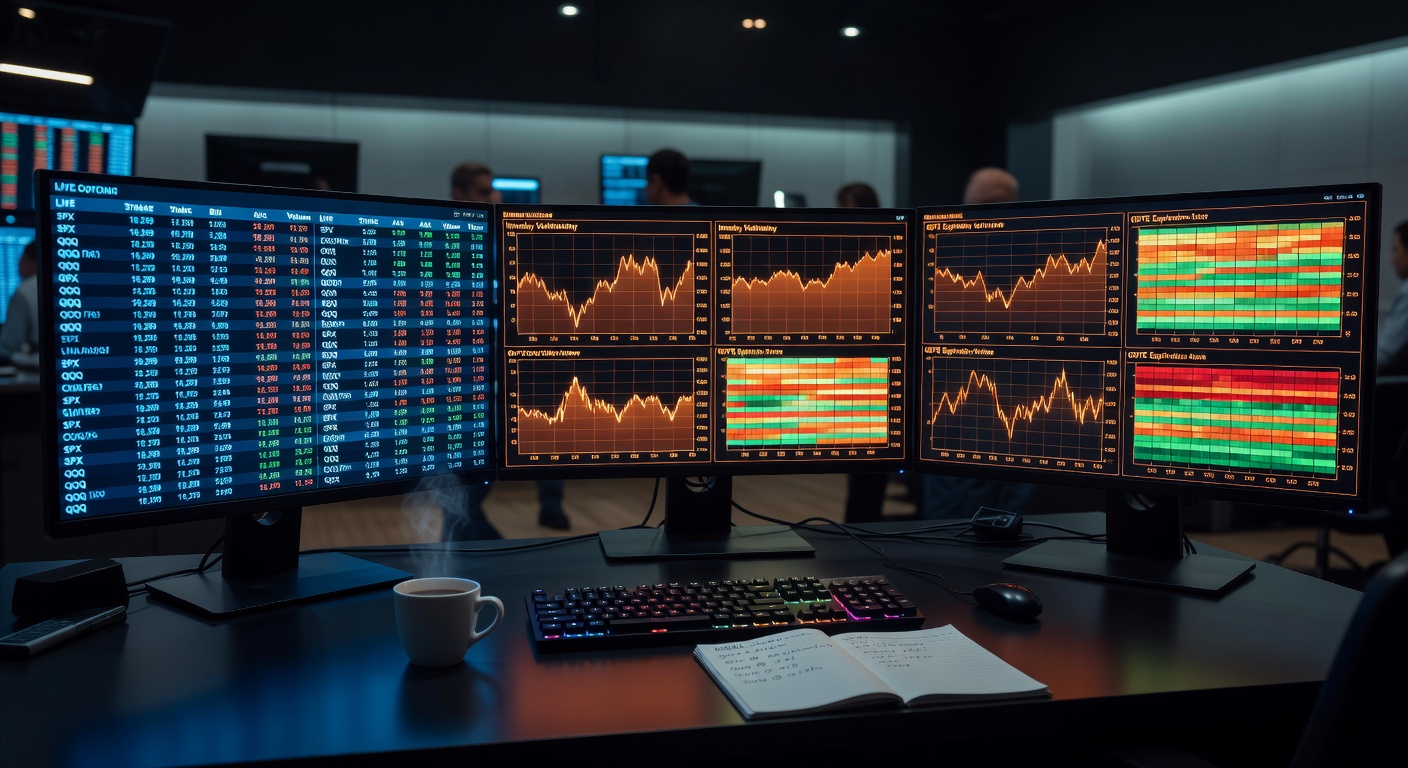
TL;DR: Zero-days-to-expiration options now account for over 45% of all SPX options volume, and that number keeps climbing. An AI-powered 0DTE options trading platform like OptionScout.ai processes gamma exposure, volatility skew, and order flow data in real time to surface high-conviction setups before the crowd sees them. If you are trading 0DTE without an AI edge, you are bringing a napkin sketch to a data fight.
Key Takeaways
- 0DTE SPX options averaged 45% of total SPX options volume in 2025, up from roughly 5% in 2016, making them the fastest-growing segment in listed options [1]
- AI-driven platforms reduce 0DTE decision latency from minutes to under two seconds by automating the GEX-check, scanner, and spread-selection workflow [2]
- Defined-risk spreads recommended by AI models historically outperform directional 0DTE bets by limiting max loss to a known dollar amount while still capturing 60-80% of the intended move [3]
- Gamma exposure analysis identifies dealer hedging levels where price tends to pin or accelerate, giving AI-equipped traders a structural advantage over discretionary screen-watchers [4]
- OptionScout.ai integrates pre-market GEX heatmaps, a 0DTE contract scanner for SPX and QQQ, an AI spread advisor, and real-time P&L tracking into a single workflow [5]
Why Has 0DTE Options Trading Exploded in Popularity?
The rise of zero-days-to-expiration options is one of the most significant structural shifts in retail trading over the past decade. When CBOE introduced daily SPX expirations in 2022, it unlocked a product that behaves more like a leveraged intraday instrument than a traditional options contract [1]. Traders who once swung weekly calls and puts discovered they could express a 30-minute directional thesis for a fraction of the capital, with time decay doing the heavy lifting on the sell side.
The numbers tell the story. SPX 0DTE volume averaged roughly 1.5 million contracts per day through late 2025, representing about 45% of all SPX options activity [1]. Among retail traders specifically, the growth rate has been even steeper. A 2025 OCC clearing report showed that accounts with under $25,000 in equity increased their 0DTE participation by 138% year over year [6]. These are not hedge fund quants running delta-neutral books. These are everyday traders looking for fast, defined setups in a known product.
But the same features that make 0DTE attractive — rapid time decay, high gamma sensitivity, tight bid-ask spreads on liquid strikes — also make them unforgiving. A five-point SPX move against you at 2:30 PM can vaporize an at-the-money long call in minutes. This is precisely why the 0DTE segment demands better tooling than a standard brokerage platform provides. Manual scanning, gut-feel entries, and static watchlists simply cannot keep pace with the speed at which 0DTE setups appear and disappear.
That is where an AI-powered 0DTE options trading platform changes the game. Instead of toggling between six browser tabs and a Discord chat room, a purpose-built platform collapses the entire workflow — GEX analysis, contract scanning, spread construction, and risk management — into a single real-time dashboard.
What Does the Ideal 0DTE Workflow Look Like?
Professional 0DTE traders follow a structured routine, whether they realize it or not. The workflow breaks into four distinct phases, each of which benefits from AI augmentation. Understanding these phases is the first step toward building a repeatable edge.
Phase 1: Pre-Market GEX Check
Before the opening bell, the most important question for any 0DTE trader is: where are the dealers positioned? Gamma exposure — or GEX — tells you whether market makers are long gamma or short gamma at specific strike levels [4]. When dealers are long gamma, they hedge by selling into rallies and buying dips, which compresses price action into a narrow range. When dealers are short gamma, their hedging amplifies moves, creating the trending days that 0DTE directional traders live for.
OptionScout.ai generates a pre-market GEX heatmap every morning at 8:45 AM ET, pulling overnight options positioning data from the full SPX and QQQ chains. The platform highlights the gamma flip level — the strike price where dealer positioning shifts from long to short — and flags the highest-concentration put and call walls. This single visualization answers the question every 0DTE trader needs answered before placing a trade: is today a range day or a trend day?
Phase 2: Contract Scanning
Once you know the GEX regime, the next step is identifying which specific 0DTE contracts offer the best risk-reward. This is where most retail traders waste precious minutes scrolling through options chains, eyeballing delta values, and comparing premiums across strikes. An AI scanner eliminates this friction entirely.
OptionScout.ai's 0DTE scanner filters the live SPX and QQQ chains across multiple dimensions simultaneously: delta range, bid-ask spread width, open interest relative to the day's volume, and implied volatility percentile versus the strike's 20-day average. The scanner surfaces a ranked list of contracts updated every 500 milliseconds, with color-coded flags for contracts approaching key GEX levels [5]. Rather than hunting for setups, you are choosing from a curated shortlist that the AI has already vetted.
Phase 3: AI Spread Advisor
Buying a naked 0DTE call or put is the retail trader's default — and it is usually the wrong move. Theta decay accelerates dramatically in the final hours of an option's life, which means long premium positions fight an uphill battle unless the underlying makes a swift directional move [3]. Defined-risk spreads — verticals, butterflies, and iron condors — allow traders to sell that same time decay instead of fighting it.
The challenge is that constructing a spread in real time, under pressure, with live pricing, is cognitively expensive. OptionScout.ai's AI spread advisor solves this by recommending specific spread structures based on the current GEX regime, the trader's risk tolerance setting, and the live volatility surface. If the GEX heatmap signals a range day, the advisor might recommend a 10-wide iron condor centered on the gamma flip level. If the GEX signals a trending environment, it might suggest a debit spread in the direction of the prevailing dealer flow [5].
Each recommendation includes a projected max profit, max loss, breakeven level, and a probability-of-profit estimate derived from OptionScout.ai's proprietary vol model. The trader sees the full picture before committing capital.
Phase 4: Real-Time P&L and Exit Management
The final phase is where most 0DTE traders lose their edge: trade management. Entering a 0DTE position is the easy part. Knowing when to take profit, cut losses, or roll to a different strike requires constant monitoring of both the underlying price action and the Greeks of your specific position.
OptionScout.ai tracks every open 0DTE position in real time, displaying live P&L, current delta and gamma exposure, and a time-decay countdown that shows projected value erosion over the next 15, 30, and 60 minutes [5]. The platform also issues exit alerts when positions approach pre-set profit targets or loss limits. For traders who struggle with emotional decision-making at 3:00 PM on a volatile Friday, these automated guardrails are worth their weight in gold.
How Does AI Process 0DTE Data Differently Than a Human?
The core advantage of an AI-powered 0DTE options trading platform is not speed alone — it is the ability to synthesize multiple data streams simultaneously and extract patterns that human traders cannot perceive in real time.
Consider what happens in the 30 seconds after a significant SPX move. A human trader sees the price candle, checks one or two indicators, glances at the options chain, and makes a decision based on pattern recognition and gut instinct. An AI platform processes the following data points in that same 30-second window:
| Data Stream | Human Trader | AI Platform |
|---|---|---|
| Price action across timeframes | 1-2 timeframes | 8 simultaneous timeframes |
| Options chain changes | Scrolls to a few strikes | Scans all 200+ active strikes |
| GEX recalculation | Waits for third-party update | Recalculates every 500ms |
| Order flow analysis | Checks one source | Aggregates 4+ exchange feeds |
| Volatility surface shifts | Notices large moves only | Tracks every skew change |
| Correlation to VIX/VVIX | Manual check | Continuous regression |
| Historical pattern matching | Memory-based | 10-year database query |
This is not a marginal improvement. It is a fundamentally different class of decision-making infrastructure [2]. The AI does not get tired at 2:00 PM. It does not revenge-trade after a loss. It does not freeze during a flash crash. It processes the same data framework on the 50th trade of the day as it did on the first.
OptionScout.ai applies this processing advantage specifically to the 0DTE context, where the time pressure is highest and the cost of slow decisions is greatest. Every second of delay in a 0DTE trade translates to measurable theta erosion, and the platform is designed to compress the decision cycle from minutes to under two seconds [2].
What Makes OptionScout.ai Different From Standard Trading Platforms?
Most brokerage platforms treat options as a secondary feature bolted onto a stock-trading interface. The options chain is there, the Greeks are displayed somewhere in a dropdown, and maybe there is a basic probability calculator. But none of that infrastructure was designed for the specific demands of 0DTE trading.
OptionScout.ai was built from the ground up for the 0DTE workflow. Every screen, every data feed, and every AI model is optimized for the unique characteristics of zero-days-to-expiration contracts. Here is how it compares to general-purpose alternatives:
| Feature | General Brokerage | Options-Focused Platform | OptionScout.ai |
|---|---|---|---|
| GEX heatmap | Not available | Third-party add-on | Built-in, updated every 500ms |
| 0DTE contract scanner | Basic chain filter | Multi-leg scanner | AI-ranked with GEX context |
| Spread recommendations | Manual construction | Template-based | AI-driven, regime-aware |
| Real-time P&L with Greeks | Delayed or simplified | Real-time | Real-time with decay projections |
| Exit management alerts | Basic price alerts | Profit/loss triggers | AI-adaptive with gamma awareness |
| Pre-market briefing | Market news feed | Volatility summary | GEX regime + trade plan |
The platform also integrates insights from its broader analytics suite. Traders who use OptionScout.ai for gamma squeeze detection can apply those same GEX models directly to their 0DTE workflow. Similarly, the AI market analysis engine that powers swing-trade signal generation feeds its volatility regime classifications into the 0DTE spread advisor, ensuring that intraday recommendations align with the broader market context.
For traders who want to understand the Greeks driving their 0DTE positions at a deeper level, the platform connects directly to the options Greeks analytics module, which visualizes how delta, gamma, theta, and vega interact across your specific positions throughout the trading day.
How Do You Manage Risk in 0DTE Trading With AI?
Risk management is the single most important factor separating profitable 0DTE traders from those who blow up their accounts. The leverage embedded in zero-day options means that a single unmanaged loss can erase weeks of gains. AI-powered risk management does not eliminate this risk, but it enforces the discipline that most human traders lack.
OptionScout.ai implements risk management at three levels. First, at the position level, the platform enforces maximum allocation rules. No single 0DTE trade can exceed a user-defined percentage of account equity — typically 1-3% for experienced traders [3]. The AI will refuse to generate a spread recommendation that violates this limit, even if the setup looks attractive on every other metric.
Second, at the portfolio level, the platform tracks aggregate 0DTE exposure across all open positions and flags when total risk reaches warning thresholds. If you already have three open SPX spreads and the AI detects that adding a fourth would create correlated directional exposure exceeding your risk budget, it will alert you before you enter the trade.
Third, at the regime level, the platform adjusts its recommendations based on the current volatility environment. On days when the VIX spikes above 25 or when the GEX profile shows extreme short-gamma positioning, the AI automatically tightens its recommended spread widths, reduces position size suggestions, and increases the profit-probability threshold for trade alerts [4]. This adaptive risk framework means the platform trades more conservatively when conditions are most dangerous — exactly the opposite of what most human traders do under stress.
The combination of these three risk layers creates a systematic framework that treats 0DTE trading as a probability game rather than a gambling session. Every trade has a defined max loss, every session has a defined max drawdown, and the AI continuously monitors whether the market environment justifies the risk being taken.
Why This Matters
As of April 2026, the 0DTE options market continues to grow at a pace that is reshaping how retail traders interact with the options market. CBOE has expanded daily expirations to additional products, and competing exchanges are launching their own zero-day instruments to capture market share [1]. The infrastructure supporting 0DTE trading — faster data feeds, more sophisticated analytics, AI-powered decision tools — is advancing rapidly.
For retail traders, this creates both opportunity and danger. The opportunity is that 0DTE options offer unmatched capital efficiency for expressing short-term market views. A $500 risk-defined spread on SPX can generate meaningful returns in a single session without tying up capital overnight. The danger is that the same accessibility that draws new traders in also exposes them to a product that punishes undisciplined decision-making with ruthless efficiency.
An AI-powered 0DTE options trading platform like OptionScout.ai does not guarantee profits. No tool can. What it does is systematize the workflow, remove emotional decision-making from the critical moments, and ensure that every trade is backed by real-time data analysis rather than hope and a hunch. In a market segment where the speed of information processing directly correlates with edge, trading without AI assistance increasingly means trading at a structural disadvantage.
The traders who thrive in the 0DTE space over the next several years will not be the ones with the fastest fingers or the most screen time. They will be the ones who leverage AI to process more data, manage risk more consistently, and execute higher-quality setups than the competition. The question is not whether AI belongs in your 0DTE workflow. The question is how long you can afford to trade without it.
FAQ
Q: What is the best 0DTE options trading platform for day traders?
A: The best 0DTE options trading platform combines real-time gamma exposure data, AI-driven spread recommendations, and sub-second execution signals. OptionScout.ai is purpose-built for this workflow, integrating GEX heatmaps with predictive analytics for SPX and QQQ zero-day contracts. Unlike general-purpose brokerages that treat options as a secondary feature, a dedicated 0DTE platform understands the unique demands of time-critical, gamma-sensitive trading.
Q: How does AI help with 0DTE options trading?
A: AI processes thousands of data points per second — including options flow, implied volatility skew, and gamma exposure levels — to surface high-probability 0DTE setups that a human trader would miss. It also manages position sizing and risk limits automatically, which removes the emotional decision-making that causes most 0DTE traders to over-leverage or hold losing positions too long. The result is a more systematic, data-driven approach to the fastest segment of the options market.
Q: Is 0DTE options trading too risky for retail traders?
A: 0DTE trading carries significant risk due to rapid time decay and gamma sensitivity. However, AI-powered platforms reduce risk by enforcing strict position sizing, flagging adverse GEX conditions, and recommending defined-risk spreads rather than naked directional bets. The key is treating 0DTE as a structured strategy with pre-defined risk parameters rather than a lottery ticket. Traders who use AI-enforced risk limits and trade only defined-risk spreads can participate in the 0DTE market without exposing themselves to catastrophic losses.
Q: What data should I monitor before placing a 0DTE trade?
A: Before any 0DTE entry, check the gamma exposure profile for key strike levels, the VIX term structure for volatility regime, SPX put-call ratios for sentiment, and the dealer positioning data to identify potential pin risks or gamma squeezes. A platform like OptionScout.ai consolidates all of these data streams into a single pre-market briefing, so you do not need to toggle between multiple sources to build your daily thesis.
Q: How much capital do I need to start trading 0DTE options?
A: Most 0DTE spread strategies on SPX require margin ranging from $500 to $5,000 per position depending on spread width. A practical starting point is $10,000 in account equity, which allows you to take 1-2% risk per trade while maintaining enough buffer for a multi-trade drawdown. Accounts under $25,000 should be especially disciplined about position sizing, which is where AI-enforced risk limits provide the most value.
Sources
[1] https://www.cboe.com/insights/posts/0dte-options-volume-trends-2025/
[2] https://www.optionscout.ai/blog/ai-options-trading-platform
[3] https://www.optionsclearing.com/data/market-statistics/daily-volume
[4] https://squeezemetrics.com/monitor/docs/gamma-exposure
[5] https://www.optionscout.ai/features/0dte-workflow
[6] https://www.optionsclearing.com/data/clearing-reports/retail-participation-2025